
สำนักงานวิเทศสัมพันธ์ สำนักงานอธิการบดี 2024/09/09 , ( 549 views)
Assistant Professor Dr. Pratchayaporn Wanchai from the Department of Biological Sciences, Faculty of Science, Ubon Ratchathani University (UBU), collaborated with a research team from Kasetsart University and La Sierra University in the United States, to identify a new species of Leiolepis lizard in Ubon Ratchathani Province. This study was funded by the National Research Council of Thailand and the Centre of Excellence on Biodiversity, with the findings published in the journal ZooKeys.
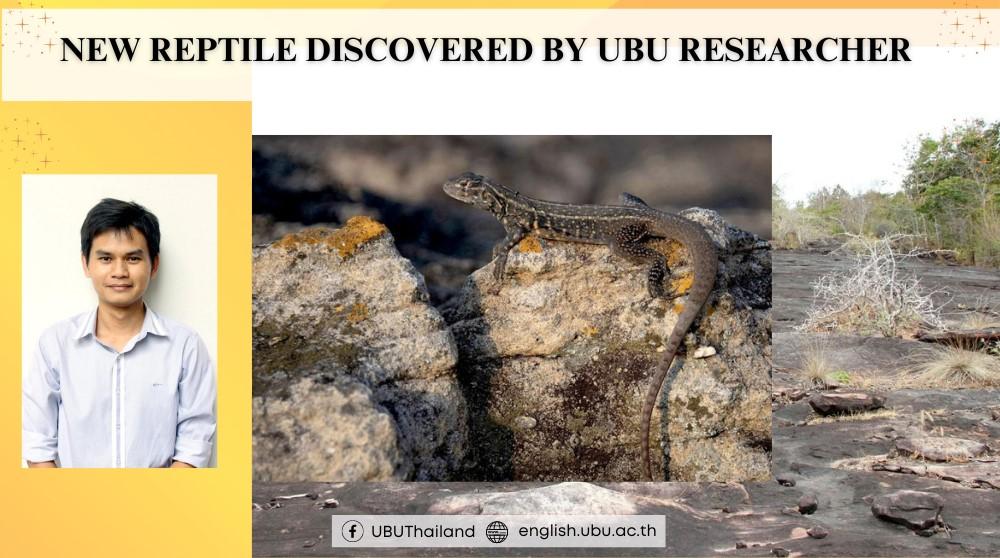
The research team reported the discovery of Leiolepis glaurung, locally known as "Yab" or "Yaab." This species is the first in the Leiolepis genus to adapt to sandstone mountainous regions, where it burrows between soil layers and stones. This behavior contrasts with other species in the same genus, which typically inhabit lowland areas and dig burrows in the ground. The researchers hypothesize that this adaptation helps reduce competition with Leiolepis rubritaeniata (the Isan Lizard) in the same habitat.
The new species has only been reported in the Korat Plateau and the Phu Phan mountain range, in Ubon Ratchathani, Nakhon Ratchasima, and Chaiyaphum provinces.
Morphologically, Leiolepis glaurung is characterized by a gray to nearly black coloration on its head, body, legs, and tail. The body’s sides exhibit an orange-yellow hue, featuring a single black transverse stripe on the posterior of the forelimbs, followed by a pale-yellow stripe with small yellow spots. The lower sides of the body show minimal to no lateral expansion. The neck is black with a broad yellow stripe, while the abdomen is yellow with black spots. The underside of the tail ranges in color from bright red to orange.
The species name "glaurung" is derived from the ancient dragon in J.R.R. Tolkien's Middle Earth, as described in The Silmarillion. This reference reflects the golden-yellow color of the lizard’s abdomen and its burrowing behavior under rocks, which resembles the dragon Glaurung (named by Assistant Professor Dr. Jesse Grismer).
This discovery represents a significant achievement and a source of pride for UBU. The successful identification of a new species within Ubon Ratchathani Province aligns with the university’s mission and strategic objectives to produce high-quality research that sustainably enhances the quality of life and promotes economic development in the region, strengthening the university’s international reputation.
English version by: Kanjana Manomai
Original (Thai) version by: Tippawan Valuvanathorn
English revised by: James K. Powell II
Photos by: Faculty of Science